Art Installation in New York: How We Install Large-Scale Work
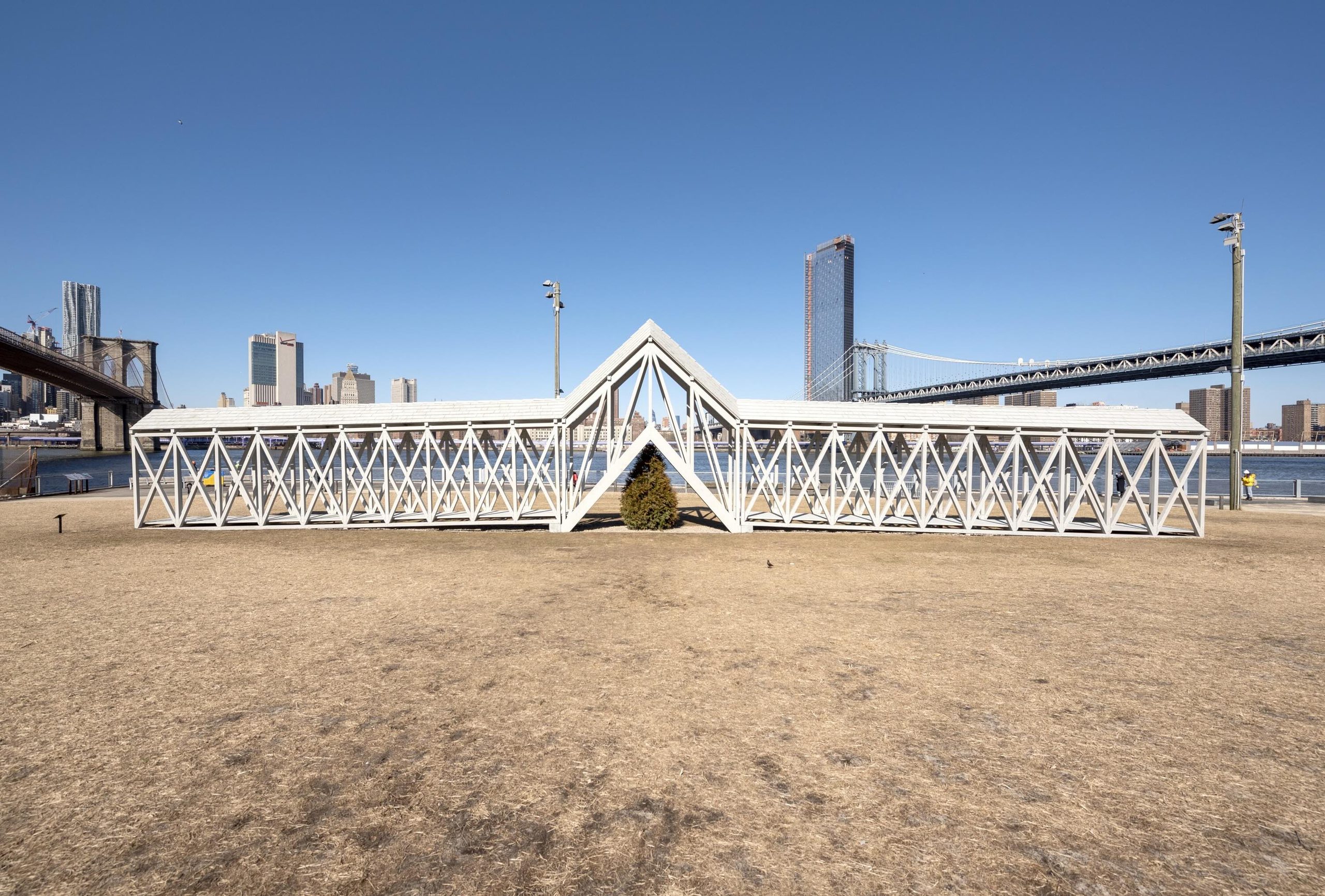
Many of the buildings Eurostruct builds are for art: galleries, foundations and cultural institutions across New York. Some of the work is the art itself. As an art installation company in New York, we have installed Tony Cragg’s Monumental Sculptures along Park Avenue for Marian Goodman Gallery, Siah Armajani’s Bridge Over Tree on the Brooklyn waterfront for Public Art Fund, and Doug Wheeler’s D-N SF 12 PG VI 14 inside Palazzo Grassi in Venice. This is what those projects taught us, written for galleries, artists’ studios, curators and public art organizations.
A large artwork is also a structure
Bridge Over Tree is a 91-foot covered walkway of wood and steel, with a central stair that climbs up and over a single evergreen tree. Armajani first showed it at the Walker Art Center in Minneapolis in 1970; the Public Art Fund staging in 2019 was its first in nearly 50 years. It stood on Empire Fulton Ferry Lawn, framed by the Manhattan and Brooklyn Bridges, and was open to the public from February to September.
A walkway open to the public is carpentry, steel and stairs as much as it is sculpture. Those are the trades we manage every day as a general contractor, and they are what an installation like this needs: drawings checked before anything is built, parts that fit on site, and work assembled to the artist’s intent.
Placing sculpture on a busy avenue
For Monumental Sculptures in 2018, we installed five large works by Tony Cragg in polished stainless steel, bronze and fiberglass on the Park Avenue Malls between East 52nd and 79th Streets. The exhibition was presented by Marian Goodman Gallery with NYC Parks’ Art in the Parks program and the Fund for Park Avenue, and was on view from May through October.
Park Avenue doesn’t stop for an installation, so we worked overnight. We coordinated the delivery, rigging and placement of each piece, on one of Manhattan’s busiest avenues and with polished surfaces that show every mark. Night work windows and constrained sites with little room for staging are part of how we build in this city every day.
When the artwork becomes the room
Doug Wheeler’s D-N SF 12 PG VI 14 took us to Venice. The work is a seamless reinforced fiberglass shell, about 39 feet square and 24 feet high, built inside the colonnaded atrium of Palazzo Grassi, the Pinault Collection’s 18th-century palazzo on the Grand Canal. It curves up from the floor to form the walls and ceiling, and its titanium dioxide finish and computer-controlled lighting remove the shadows where surfaces meet, so visitors seem to float in white space.
Our team assembled the numbered shell segments in place from a full scaffold platform, inside a protected historic interior. The work was the centerpiece of The Illusion of Light, curated by Caroline Bourgeois, from April 2014 to January 2015. Protecting a historic interior while building inside it is also part of our historic restoration and landmarked-building work in New York.
Our own shops
Large works often need something made to fit them: a base, a bracket, a frame or a support that no one sells. Our millwork and steel shops in our 22,500 sq ft facility in Greenpoint, Brooklyn, make:
- armatures, brackets and art-hanging supports;
- structural steel and architectural metal;
- plinths, display cases and vitrines;
- finish samples and mockups, so details can be approved before they are built.
Questions to settle before installation day
Every installation is different, but the same questions decide whether the day goes to plan:
- The work: the weight and size of each piece and crate, how it is lifted, and which surfaces can’t be touched.
- The route: where a truck can stop, what it passes through on the way, and what the ground or floor along the way can carry.
- The site: who owns it and what they need to approve, from a park or a building owner to a landmarks commission.
- The time: when the work can happen (overnight, before opening, between exhibitions) and the date the public arrives.
- The people: coordination with the artist’s studio, art handlers, registrars and conservators, with one person responsible for the plan.
- The end: temporary works come down again. Both New York installations above were on view for a season, so plan the removal, and how the site is left, from the start.
Working with us
Eurostruct has built in New York since 1988, with about 150 people and project managers on site. Installations draw on the same people, shops and planning as the galleries we build. See all of our art installation projects, or get in touch to talk through your artwork, site and dates.